Make no mistake – 3D is an add-on feature for HDTV today. Any 3D display should be foremost judged by its 2D display capabilities, because that’s mainly what you’ll use it for. Compatibility with 3D Blu-ray discs is just icing on your high-def cake. With that said, by 2014, it’s estimated that 40 percent of all HDTVs sold will include 3D capability, which means you’ll need to know what you’re getting into before you’re persuaded as to whether active or passive 3D is the better choice.
Passive 3D Technology
Passive 3D has been making inroads in the last year as the economical 3D choice forconsumers. At this year’s Consumer Electronics Show (CES), LG touted a study that said 80 percent of consumers prefer passive 3D technology. The study was conducted by Morpace but was commissioned by LG. LG claims the study was not biased because it has been producing both active and passive display types, but says the study makes its strategy for the future clear – people prefer the passive 3D experience.
Passive 3D Advantages
- Low cost 3D glasses
- Lightweight glasses for comfort
- No 60Hz shuttering means fatigue-free viewing
Passive 3D Drawbacks
- Loss of true 1080P resolution
- Manufacturer support currently limited
- Display technology limited to LCD / LED-type displays
Film director James Cameron famously threw his hat into the passive 3D camp at a recent gathering of the National Association of Broadcasters (NAB). Cameron told audiences that he sees passive 3DTV technology taking over in the short-term, but ultimately he says the real choice in 3DTV is still about five years away when we'll have:
"…high quality, full HD-resolution large screens that have multiple viewing angles that don’t have glasses at all. That is the point where the curve will go ballistic."
The first difference you’ll notice between active and passive 3D technology is theglasses. Active 3D is so named because its glasses are active-shutter devices that run on internal batteries that need to be recharged. They create a 3D effect by alternately shutting off light to each eye at a rate of 60 times per-second (60Hz). In this sense they are essentially two small LCD screens.
Passive 3D uses lightweight glasses with no electronics, just polarized lenses similar to the kind you've used at the movie theater. Compared to active lenses, passive glasses are cheap, lightweight and comfortable.
But when it comes to picture quality, proponents say only active 3D gives viewers a real high-definition 3D experience, because passive 3D robs them of half the display's lines of resolution.
The Passive 3D Resolution Controversy
As expected with new consumer technologies, confusion and misunderstanding on 3D technology abounds. Half-truths and misinformation are being dispensed like Pez candy from the throat of your favorite cartoon character in the interest of sales and marketing hype – so let’s cut through the muck.
Active 3D Advantages
- Higher resolution and detail
- Plasma compatible for highest-possible 3D picture quality
- More manufacturers currently building active 3D panels
Active 3D Drawbacks
- Visible flicker could be an issue (Editor: It IS an issue)
- Loss of brightness
- Pricey glasses costing $50 - $130 per pair
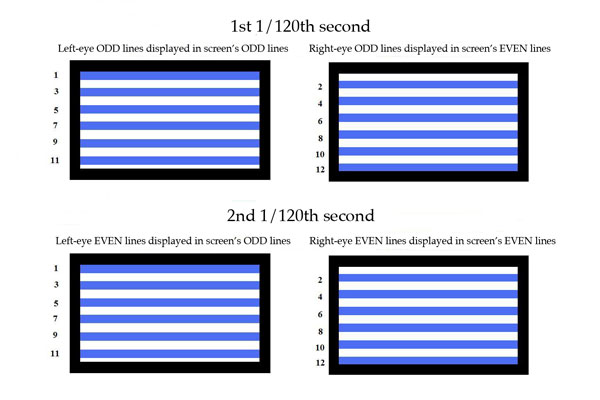
Passive 3D flat panels work by using a form of interlacing, like your old CRT television set. Another name for passive 3D is FPR because it uses a Film Pattern Retarder filter on the screen to oppositely polarize alternating lines in the image—the left eye sees the odd-numbered lines, while the right eye sees the even-numbered lines, then vice-versa at a rate of 120 times per second (Hz).
This is why it's said that passive 3D technology is only "half-resolution". An HDTV displays 1080 lines of vertical resolution. At any one time using a passive display, you're only seeing 540 lines.
Passive 3D manufacturers like LG and Vizio will say that even though each eye only sees 540 lines of resolution, the brain combines the two into a single 1080P image – hence you're getting the full HD resolution in your viewing. This fact allows manufacturers to get away with calling passive a true 3D-HDTV technology. But it's not that simple.
Digital Video Essentials Disagrees
Display experts like Joe Kane, founder of Joe Kane Productions and creator of the famous Digital Video Essentials calibration discs, disputes this conclusion. Kane says that the two images must be kept completely isolated from each other or you don't get the 3D effect at all – when each eye sees only 540 lines, 540 is the total effective resolution.
This is why, Kane says, thin black horizontal lines are often visible when viewing passive 3D-effects when you get too close to the screen. According to him, this proves that the brain does not combine the two images. If it did, the black lines would not be visible from any distance. Of course, when you sit far enough away from your passive 3D display you can't see the black lines anymore, but it also reduces the detail you can see in the 3D images and makes for a slightly less immersive 3D experience.
Editor's note: We love Joe Kane and respect him highly as an industry professional who really knows his stuff. In this case, however, we respectfully disagree on the significance (not the reality) of the reduced resolution and would just tell consumers to not sit too close to the screen.
The LG Take on Passive 3D Resolution
Naturally, if you ask engineers at dedicated passive-backer LG, you'll get a different story about passive 3D resolution. LG is quick to point out that you get the full 1080 lines of resolution in each eye, just not at the same time. While it's true you only get 540 lines of resolution at any one time the image is interlaced at a 120Hz refresh rate, alternating between odd and even lines of resolutions every 1/120th of a second. This is much higher refresh rate than the 60Hz flicker-rate you get from active 3D lenses, which, as LG points out, are prone to visible flicker for some viewers.

So, LG is saying that technically inside 1/60th of a second (that's the display refresh rate of 120Hz divided by 2, or 60Hz - which is the video refresh rate of the Blu-ray format) you are getting all 1080 lines sequentially in each eye, just not in the same pass. It's this method that gives LG the right to claim that its 3D display technology shows all 1080 lines of resolution stored on the 3D Blu-ray disc.
Active 3D Criticism
So, is active 3D the clearly superior picture quality? Most side-by-side comparisonsshow that active 3D gives viewers the edge in resolution and fine detail, but that the 3D display technology is not without its problems.
The first issue most critics will cite with active 3D is the glasses. Each pair of glasses is an electronic device with a built-in battery that must be recharged after approximately 70 hours of use. As we've seen, active 3D glasses are heavy and expensive compared to passive. If you want to have a bunch of friends over to watch your new active 3D rig, be prepared to shell out up $130 per-pair of glasses. In a push to reduce the high cost associated with active 3D, Samsung has recently reduced the price of its basic active 3D glasses to a more manageable $50 per pair.

Next, you have to consider that active 3D glasses use electronic lenses that literallyshutter vision alternatively from each eye 60 times per second (60Hz). Since each eye gets the full 1080 lines of resolution at the same time, active 3D gets the resolution advantage over passive technology, but because the shutter effect literally closes off light to one eye at a time, the use of active 3D glasses is said to cut brightness significantly. With a drop in brightness comes less fine detail in coloration and shadows.
Editor's Note: Now you can compensate for this, but who's tracking how well calibrators are taking into account this reduced brightness and contrast when calibrating new sets for 3D use? Another issue is the fact that new televisions aren't storing 3D picture modes with compensation for this loss in light output that come on automatically when in those modes. 3D still uses, for the most part, the 2D picture mode settings. Got that new TV calibrated? Not anymore when you watch 3D content, unless you calibrated a manual setting.
Visible flicker is also a relatively common complaint about active 3D technology. While many claim not to be bothered by, or even see the 60Hz flicker, others report symptoms of viewer fatigue or even headaches during extended sessions on an active 3D panel.
Active / Passive Comparison
Side-by-side comparisons between the two technologies generally give the nod to active when it comes to visible detail, with fewer jagged lines. It also seems active technology stands up better to viewing the display from close to the screen.
One reviewer says: "I still see thin, black horizontal lines on FPR flat panels, especially in large single-color areas and text, that are not visible on active sets. And FPR sets exhibit lots of crosstalk when viewed from much above or below the central axis, so anyone watching from the floor won't have a satisfying experience."
When it comes to consumer electronics technology, your choices are never simple. But freedom of choice is the essence of consumer empowerment. And with the current state of 3D technology, there is no clear superior choice. Learn first - then decide which choice is right for you.
Ultimately we think Cameron is right, the future of 3D has to be glasses-free. The demonstrations we've seen at CES so far are experimental on tiny displays, but researchers are currently work


 With around 400 top of their field