Management magazine search

Loading

Thursday, September 1, 2011

How much better is the Super AMOLED Plus display? | Android and Me

How much better is the Super AMOLED Plus display? | Android and Me:

One of the most anticipated devices this year is the Samsung Galaxy S II, which is bringing a new display technology – Super AMOLED Plus (also found in the Droid Charge). Of course, this is simply the next generation of the same screen technology that Samsung has been using for pretty much all of its Android devices (Super AMOLED).

Since the announcement of this new technology, we have all been wondering how much Super AMOLED displays can really be improved. Super AMOLED displays provide about the richest display experiences, and it is one of the main reasons why some people prefer Samsung devices. Such technology is already known for being among the best in the market, and it seems unlikely that this “Plus” can make that huge of a difference (at least to the naked eye). For all of those wondering, Engadget has put together a video that proves how Super AMOLED Plus will provide better definition, by providing more sub-pixels per pixel.

Super AMOLED display (8 sub-pixels per pixel) vs. Super AMOLED Plus display (12 sub-pixels per pixel)

As you can see in the images, the older generation had more elongated green sub-pixels, while the blue and red ones are shorter and thicker. Super AMOLED Plus technology has equal size and quantity of the different colored sub-pixels, as well as having them pressed together tighter (hence the higher sub-pixelation).

I personally haven’t had a chance to see one of these Super AMOLED Plus displays in person, but I assume that the change should be almost unnoticeable. To Check out the video, head over to Engadget and take a closer look. Do you guys think this new technology is that much better? Has anyone seen one of these yet?

Samsung Galaxy Tab 7.7 Revealed with Super AMOLED Plus Display - SlashGear

Samsung Galaxy Tab 7.7 Revealed with Super AMOLED Plus Display - SlashGear: "
Samsung Galaxy Tab 7.7 Revealed with Super AMOLED Plus Display"

What we’ve come to understand is the world’s first mobile tablet utilizing the ultra-bright and lovely Super AMOLED Plus display from Samsung is the Galaxy Tab 7.7, a 7-inch device made for ultimate viewing quality and portability. It’s this week at IFA 2011 in Berlin that we’re being shown some of the biggest and brightest Android-based devices Samsung has ever offered up, this 7.7-inch display-having tablet now what’s essentially the biggest brightest tablet on earth. This tablet also features a fantastically powerful 1.4GHz dual-core processor as well as an ultra-small chassis at just 7.89 millimeters thin and 335 grams (12 ounces) in weight.

We’ve previously experienced this most impressive bright and brilliant technology in the Super AMOLED Plus on the recently released Samsung Infuse 4G and as recently as earlier this week on several newmodels of the Samsung Galaxy S II as revealed in New York City. Compared to essentially any competitor’s smartphone or tablet display technology, Samsung’s Super AMOLED Plus display ends up being the clear winner as far as clarity and overall abilities in brightness go.

The Samsung Galaxy Tab 7.7 comes in a lovely metal casing with rounded edges for both a high-quality feel and a portability unmatched in the Galaxy Tab lineup thus far (at least as far as Honyecomb tablets go, that is.) This device will be working on your HSPA+ 21 Mbps network carrier for true mobile abilities, you able to access data and internet wherever you go quickly becoming the only way to fly, especially in tablet form. This device is powered by an unnamed 1.4 GHz dual-core processor, it’s display’s resolution sits at 1280 x 800 (WXGA) on a 7.7-inch screen, and its utterly massive 5,100 mAh battery should keep you chugging along for days on end, no problem. Unlike the Samsung Galaxy Tab 10.1, this newest tablet has a microSD card slot into which you can insert up to a 32GB card for memory expansion galore.

You’ll be working with the newest version of Google’s Android mobile operating system Android 3.2 Honeycomb with Samsung’s newest TouchWiz UX user interface working on top of Android to bring you a true Samsung experience. You’ve got full 1080p video playback, DivX included multi codec and Universal Remote Control functionality able to work with your TV, Set top box, DVD player, Blu-ray player, AV audio system, and more!

Like all recent Samsung releases, this device has access to Samsung’s several “Hub” access points for media including Game Hub, Music Hub, Social Hub, and Readers Hub. The newest of these is the Game Hub, the Galaxy Tab 7.7 being the first Samsung device to come with it out of the box, it containing social games, all the social games your heart could possibly desire. Finally there’s Voice and Video support – speak directly to your tablet in a video chat for clear video and voice or set your device for Receiver Mode for a more private talk.

Follow along with us LIVE for the rest of the Samsung Unpacked event at IFA 2011 for total coverage of every Samsung device we’ll be marveling over for weeks and months to come!

Homeshopping.pk wins the Brand of the Year Award 2010 | Home Shopping Pakistan's BLOG

Homeshopping.pk wins the Brand of the Year Award 2010 | Home Shopping Pakistan's BLOG: "Homeshopping.pk wins the Brand of the Year Award 2010"

HomeShopping.pk has been awarded the Brand of the Year Award 2010. Our company has beaten the competition by a margin, becoming the first company in the history of the award to capture the top spot in less than three years since the beginning of operations. This journey has been great and this has only been possible by the response and love we have got from our loyal customers. We have been providing customers with high quality products at absolutely unbeatable prices in Pakistan since our inception and have really focused on customer support and after sales services unlike many other companies which has resulted in our customers responding back . We spearheaded the revolution of online retail in Pakistan by introducing policies never seen before in Pakistan, including our 7 day return policy, our payment t door-step policy, our EasyPaisa payment system, Homeshopping Blog to let our customers know everything about what they are buying and other newer products etc. We have been working hard to bring as much comfort and pleasure as we possibly can to your online purchase and are committed to improving our services well above a current levels with your help, love and support. Below you can see a few glimpses of the event, including a snap of our CEO receiving the award

About ShopAtHome.com - SAH

About ShopAtHome.com - SAH: "About ShopAtHome.com"


ShopAtHome.com is one of the largest websites offering free online coupons, grocery coupons, cash back rewards, free samples, restaurant coupons and contests. The site is unique from other online deal sites because it gives cash back to shoppers for purchases made through ShopAtHome.com.

QUICK FACTS

  • 37 million visits a month in 2010
  • 800 free product samples
  • 50,000 stores
  • Over 1,200 grocery coupons
  • Members have earned over $50 million in Cash Back

GROWTH

ShopAtHome.com has experienced unbelievable growth year-over-year since it was launched in 1986. Over the past year, it's monthly visits have grown from 19 million to over 37 million with no signs of slowing down.

HISTORY

ShopAtHome.com was founded in 1986 by husband and wife team Marc and Claudia Braunstein at their home in Denver. ShopAtHome.com started as a company offering a "Catalog of Catalogs," and, through feedback from users and advances in technology, has become the online coupon powerhouse it is today, with more than 50 employees, including an entire team dedicated to scouring the web for coupons and deals.

Through its partnership with thousands of online retailers, catalogs and magazines, ShopAtHome.com fulfills its mission of offering the latest products, up-to-the-minute deals and Cash Back for consumers who shop online while it generates targeted leads for the direct response industry.

ShopAtHome.com is a division of the Belcaro Group, Inc. located in Denver, Colo. and is a member of the Better Business Bureau.

ShopAtHome.com Member Demographics

The average ShopAtHome.com User is:

  • Median age 35
  • Household income more than $75K per year
  • 63 percent of users are women / 37 percent are men

ShopAtHome.com Features

  • Cash Back Shopping - up to 35 percent Cash Back, Daily Deals featuring Extra Cash Back , free shipping for selected orders, exclusive double and triple Cash Back promotions
  • Free Coupons - Exclusive discounts, free shipping offers, limited time specials
  • Printable Grocery Coupons - 3 collections of gorcery coupons that consumers can print and take to their favorite stores. Coupons are updated frequently, but supplies are limited. Requires the Free Coupon Toolbar and special coupon drivers to prevent coupon fraud.
  • Local Store Coupons - Printable coupons for local stores. Consumers can print and save on auto upkeep, pizza, restaurants and more. Requires the Free Coupon Toolbar.
  • Free Coupons Toolbar - downloadable application that gains exclusive access to Printable Grocery Coupons, Local Store Coupons and more
  • ShopAtHome.com's WILD: A deeply discounted deal everyday from top merchants - up to 90% off retail prices.
For more information, become a fan on our Facebook coupons page, follow us to get Twitter coupons, and check out our Coupons Blog.

Balloon Mapping | publiclaboratory.org

Balloon Mapping | publiclaboratory.org: "Balloon Mapping"


Over the last year, we’ve build a global community of mappers who are engaged in civic issues with low-cost mapping tools like balloons, kites, and remote-control airplanes.

We're helping citizens on the Gulf Coast use balloons and kites to produce their own aerial imagery of the Deepwater Horizon oil spill… documentation that will be essential for environmental and legal use in coming yeas.We believe in complete open access to spill imagery and are releasing all imagery from the oil spill mapping project into the public domain. Download the data for this project athttp://grassrootsmapping.org/data

Check out the community blog at http://grassrootsmapping.org/

Get started

Do you have a site in mind which you'd like to map? Looking for collaborators or just need some tips and advice?

When getting in touch, be sure to mention:

  • the coordinates of the site
  • context; what you'd like to use the data for

Making your map

Once you have some aerial images:

Variations

  • Kite mapping - A large kite photography community exists -- find online resources and a list of recommended kites.

Advanced techniques:

AttachmentSize
A 5-page illustrated guide to balloon mapping1.26 MB

BBC News - Microsoft Mango: Windows Phone 7 look for Nokia mobiles

BBC News - Microsoft Mango: Windows Phone 7 look for Nokia mobiles: "Microsoft Mango: Windows Phone 7 look for Nokia mobiles"


Kite-Balloon Hybrid | publiclaboratory.org

Kite-Balloon Hybrid | publiclaboratory.org: "Kite-Balloon Hybrid"

A kite balloon combines a lifting gas with active lift structures like wings to fly in all conditions. A good design may solve the common difficulty of flying in light winds, which makes balloon mapping difficult, but still falls short of kite-flying weather. It may also help reduce helium use, and therefore price.

Developments thus far:

Materials:

While many balloon mappers use rubber or latex balloons, we've found that they deflate after only a few hours, and cannot be used more than a few times before becoming too worn and delicate. We're experimenting with Mylar (boPET film) and EVOH (Ethylene Vinyl Alcohol) with now because they are gas barriers, unlike Polyethylene (HDPE/LDPE/LLDPE) -- meaning that, once inflated, such balloons can stay inflated for days or even weeks. Like polyethylene, EVOH can be heat-seamed with a soldering iron or plastic bag sealer. Mylar must be glued.

EVOH available for sale at balloonkits.com, Heat Seaming Tutorial

Mylar should be glued with UHU Power Stic in lap joints according to forum discussion on RC Groups. UHU Power Stic doesn't appear to be for sale in the USA, but can be found on Ebay UK.

Tests
Tests are occurring on configurations of mylar sleeping bags at the Gowanus Canal site in January 2011:

Test III
A successful flight mapping based on Leif's and Liz Barry's design. Notes from flight?

Another mylar sleeping bag kite in Lima PeruJanuary 2011:

"Glometa" ready to fly
This kite was lost, pulled off its line by wind. Questions: is this the appropriate balance of active and passive lift?

Another one in Peru. This kite-balloon needed a second mylar sleeping bag to lift the camera, ruining the aerodynamics. The horizontal sleeping bag doesn't work well.
The modified design was not very aerodynamic

The Black Knight, by Jeffrey Warren, Oliver Yeh, and Reid Beels, April 2010
Black Knight 1
black knight kite balloon prototype
This kite had structural problems in its construction and broke quickly. It is an attempt at a helium sled kite. Other problems: material- it was made from polyethylene, which is not a gas barrier. Otherwise, a fine early flight and prototype.

A blimp-style kite balloon from Grassroots Mapping's NuVu Studio workshop April, 2010:
nuvu studio workshop kite balloon
This balloon was also lost, owing to a knot. Problems: Balloon does not hold its shape in pressure due to dispersion and lack of rigid structures. Material is polyethylene, which does not retain helium well.

(/place/new-york-city)
Mathew Lippincott-I built several kite balloon models in July of 2008. I didn't have a digital camera at the time, so I don't have many flight photos. My conclusion was I needed to learn more about plastic and seaming before attempting to fly one of these designs.
This ribbed balloon with internal supports seemed to fly reasonably in medium winds when inflated with air and with a tissue paper tail attached. The internal supports were taped and the envelope heat seamed, but small tears developed around the internal supports during flight. Built from .315mil HDPE.
kite balloon from 2008 with internal support structure
Earlier, I'd built a lenticular kite balloon with inflatable fins. This was before I'd found the Helikite design, whose rigid structure is far superior. I taped it together. oops! full of holes.
test kite balloon with molly, 2008

Inspiring Shapes

Sled Kites
sled kite
Sled kites with balloon re-enforcements on the sides inspired Jeffery and Leif's designs. They have a high active lift (wing lift) to static lift (gas lift) ratio. Helium here is a means of lifting a kite into higher winds at higher altitude. More ram/sled kites here.
This technology was invented by Domina Jalbert, who also experimented with kite balloons in the 1940's, and later invented the rammed air air foil. Ram-air structures also appear on the early Parseval-Sigsfeld balloon.

Lifting Bodies
Lifting bodies are high-volume shapes that produce active lift like wings do. They would be good compromise shapes for a kite balloon, allowing a high volume of lifting gas and aerodynamic stability
Lifting Body designs from Hayden Labs
Examples of kites using lifting bodies can be seen in lenticular kite balloon designs, like the commercial Southern Balloon Works Kingfisher and Allsopp Helikite.

Bowed Kites
Traditional Asian bowed kites are very stable. They are also curved like the underside of a balloon. Features of Bowed kites can be seen in the Allsopp Helikite, detailed below under "Alternatives to the blimp shape."
Rokkaku bowed kite

construction and commercial manufacturing
Mathew- I went to my local party store and looked for construction methods amenable to a kite balloon design. This turtle was the only balloon I found with a pattern of more than two gores (it has three. The turtle's main body is less wrinkled than circular party balloons, has a high volume for its size, and a flat bottom that looks like it could kite. it will probably be cheap to mass produce: it is made in a single motion out of a folded sheet of plastic, as detailed in this endearing 1927 patent for a more realistic inflatable elephant.
I flew it as a kite, giving it two tails. I couldn't get the balloon to balance right owing to the weight of the head and flippers, so and the tool balloon nose dives in the wind. A larger balloon with more helium would allow more thorough testing.

turtle party balloon as kite

Patents

History of Kite Balloon Designs

Early kite balloons were used for artillery observation, and had to be manned. Large balloons have different design constraints, but similar functions to small kite balloons. From discussions with users of contemporary small kite balloons, it appears that these cigar, sausage, or "blimp" style balloons (sometimes called photoblimps) aren't particularly stable below 15ft long. That said, early designs show the basics of kite balloon structure, strategies to maintain rigidity, and rigging concepts that we can probably learn from. In terms of shapes to pursue in development, see "Alternatives to the blimp shape" below and "Inspirations" above.

Large Kite Balloons 1896-Present
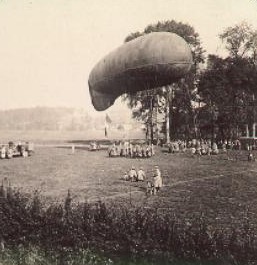
Designed during 1895 and 1896, the Parseval-Sigsfeld kite ballon (Drachenballoon, or colloquially, "sausage balloon") was the first observational balloon integrated into regular military field service. Its ability to climb into the wind and maintain its shape were due to a balloonet (listed as a diaphragm in the illustration) in the back that was inflated by a wind rushing into duct underneath, similar to the structural members of a rammed air sled kite. here is a diagram of the Parseval-Sigsfeld balloon:
Parseval-Sigsfeld kite balloon diagram

Parseval-Sigsfeld kite balloon in the field

Early experimental versions had a drag sail on the back instead of a duct. This same means of stabilization is used in the contemporary Southern Balloon Works "Kingfisher". Here is a terribly low-res image of an early experimental Parseval-Sigsfeld design:

Parseval-Sigsfeld style balloons first saw battle during the Russo-Japanese War (1903-1905), and were notably well integrated with mobile artillery by the Belgians during 1914's German invasion.

During World War I, the Parseval-Sigsfeld was replaced by the more Caquot-type balloon which looks more like a blimp, and whose design continued to evolve into the the streamlined balloons still used today for radar domes. Later Caquot-style models used a fan to forcibly pressurize their balloonet.
british barrage balloon, WWII era
This is "Fat Albert" a broadcast tower and radar dome used to watch Cuban airspace from the Florida Keys:
Fat Albert, American kite balloon lifting a radar dome off the Florida Keys
The balloonet & duct system is also used to control lift and rigidity in blimps. This diagram of the Goodyear Blimp accurately represents how the balloonets work on simpler kite balloons:
goodyear blimp internal diagram

Small Kite Balloons: 1940's to present

Amateur Radio Operators began looking for a good way to put up antennas, renewing interest in kite balloon development. Domina Jalbert Patented a kite balloon in the mid-1940's, and his design is similar to the "blimp" style Caquot balloons. His patent describes the design rather well. Jalbert used pressure and rigid structures only to maintain his kite balloon's shape, rather than rammed air ducting. All the small kite balloons I've seen do the same.
Domina Jalbert's Kite balloon for radio antennas

Contemporary Plastic Caquot Style balloon, often sold as "photo blimps." I'm not sure what brand this is:
Caquot

Alternatives to the Blimp Shape

Recently, lenticular (lens-shaped) kite balloons have emerged. From discussions with users of "photo blimps", I (mathew) have heard that at below 10-15 feet long the design is not particularly stable. The lenticular shape appears to be more stable, and it aught to be more space-efficient, having a higher volume than the blimp shape. Lenticular objects are a form of lifting body (see "Inspirations" below) and may perform as active (wing-like) lift structures.
The Helikite, manufactured by Allsopp in the UK, apparently flies in up to 40 knot winds, and yet is only 6 ft long.
The Allsopp Helikite in flight
It is notable that as well as being lenticular, the Helikite's wing structure shares features with the Japanese Rokkaku, or bowed kite (see "Inspirations" below)

Southern Balloon Works
manufactures a kite balloon called the Kingfisher that is lenticular, but uses a sail in the back for stability, like the early 1895 experimental Parseval-Sigsfeld balloon. This is curious, why use a stability strategy 115 years out of date? One of the GRM participants has used the kingfisher and says it's kind of a pain. (CITE)

The Southern Balloon Work Kingfisher:
the Southern Balloon Works KingFisher